 |
| My boys settling in for the night. They are rockstars! |
Thursday, 26 July 2012
Back and Busy
I got back from Phoenix last Thursday and jumped right into the last research project for my PhD on Friday. It's been crazy since this project involves a week of living at the farm 24/7. But, that should mean plenty of time to write. I've got plans for everything from Temple Grandin, to exotic cats to immunology.

Wednesday, 25 July 2012

Monday, 16 July 2012
Quick News from Phoenix
 |
| Phoenix as seen from South Mountain (Photo credit: Wikipedia) |
But, for now, just a quick note to say that today was awesome. I presented my poster at the graduate poster competition during the American Society of Nutrition sponsored pre-conference event yesterday. And, as a complete surprise, I won first place. Crazy-ness. I was just having fun explaining my last project. Apparently that appealed to the judges. Woohoo.
I now return you to your regularly scheduled quiet. I'll be back to normal on Thursday and hope to start writing more regularly next week.

Monday, 9 July 2012
Playing with Fire - Part 1
 |
| Propane (Photo credit: Wikipedia) |
Did I loose you there? An energeticist is a person (like me) who studies how energy is used and stored in the body. Indirect calorimetry is simply a way of measuring how much energy is being used and what the source of that energy is. It involves comparing the air that is breathed in to the air that is expired. The technique can be used for any animal, even people. Measuring the amount of oxygen disappearance and carbon dioxide appearance lets me calculate heat production, which we can equate to energy use.
So, what does all this have to do with propane? Well, by burning a known amount of propane I can calculate the amount of CO2 and O2 that should be consumped and used based on the complete combustion reaction**:
Propane (1-C3H8) + Oxygen (5-O2) --> Carbon Dioxide (3-CO2) + Water (4-H2O)
I compare these theoretical amounts to the amounts that my computer system records. This is called a percent recovery and tells me if the equipment is functioning properly.
That's the basics of testing calorimetry equipment. Any questions? I'll talk about the test-burn itself in part 2.
*Wow did I look funny. I'm much more careful about checking to see why the flame has gone out before relighting. It might be that airflow has stopped and the propane has built up in the box.
** Gah, why won't blogger let me use subscripts?


Monday, 2 July 2012
Goats on Statten Island?
 |
| An illustration of the future Fresh Kills Park. (Photo credit: Wikipedia) |
A large portion of the park is being developed into a wetlands area. The only problem? That area is currently overrun by the invasive plant phragmites.
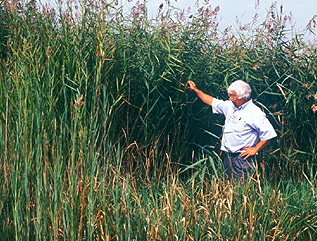 |
| Phragmites. (Photo credit: Maryland Dept. of the Environment) |
Enter the goats. Twenty Anglo-Nubians. They will be at the park for 6 weeks this summer, munching as much phragmites (and anything else they find) as they can.
Using goats to tackle difficult plants isn't anything new. This technique is call targeted or prescribed grazing. Many animals have been used to deal with excessive, unwanted vegetation; from Asian carp in overgrown streams, to cattle grazing kudzu. Growing up in Georgia, we had kudzu all over the farm. It always amazed me to see how the cattle would choose to eat it over the grass at times. Horses didn't seem to like it though. But, kudzu is a story for another day.
For now, if you are in the area, go see the goats at Freshkills park and admire some truly natural weed control at work.
 |
| An Anglo-Nubian goat attempts to eat their prize ribbon at a Scottish fair. (Photo credit: Wikipedia) |


Subscribe to:
Posts (Atom)