Showing posts with label research. Show all posts

Thursday, 25 October 2012

Counting Down

It's about to be crunch time.  I finish my animal research in 5 days.  Then I'll be in the lab and running statistics for about 2 weeks.  Then it's on to finishing the writing, setting a date, and putting the last five years work into the hands of my committee.

I haven't been great about posting regularly lately, more because unless it's fescue or energy balance it doesn't cross my path most days.  So, since I know my brain is going to need a break now and again in the next few weeks I thought I'd ask you what you'd like me to write about.

Any burning questions concerning animal nutrition, research, metabolism, or something else entirely?  Post a comment here or send me a message.  I'd love to know that what I'm writing interests you!

One of my six boys.  There might not be many of them, but they keep me busy!

Thursday, 20 September 2012

The loss of paper?


This morning I was browsing through the ASAS newsletter and stopped to read this article.
Pros and Cons of hen lab Records Go Digital

Nothing fancy, but it gets the job done!
I found myself nodding along, agreeing with the author.  I love my paper lab notebook.  It follows me from farm to field, and back to campus for the 'real lab' work.  Everything goes in.  Even if it's just a note saying that I fed and everyone is healthy and happy.  But there are things that never do make it into the lab notebook.  There are huge data files generated from indirect calorimetry and most of our analyses, from nitrogen to VFAs to Chromium and more are done by automated machines that give you a data file, not a paper result.  Those rarely get transcribed in their entirety to the notebook.

Not the time to be trying to type.
But giving up the paper completely?  No, I can't, or won't rather, take my laptop out to the farm to record pH values on rumen fluid or rumen contents weights.  I know what my papers come back looking like after that, and it it's pretty...  I can pick up a pen when my hands are in gloves and covered in who-knows-what to jot a quick note in the book, but I'd never type on a keyboard that way.  And sometimes, those notes are crucial later when analyzing the data.

Right now, I live in a world or half paper, half digital, and that's ok.  I think I manage the balance without misplacing information or forgetting what is where.  Plus, hard copies are less likely to die in an electrical storm or coffee spill (both of which I've seen happen here)!
Enhanced by Zemanta

Tuesday, 11 September 2012

Worth the Fight

Today the ag blogs have been kept busy with an idea started by Dairy Carrie.  She posted about a new song by The Departed titled Worth the Fight, which inspired her to think about how working in agriculture and agvocating was worth the fight every day, be it against the weather, animal rights activists, etc.  She asked what others in agriculture saw as worth the fight and the response has been amazing!

My roomates.
When I got to thinking about what was worth the fight, my mind went to the fact that I start a new round of experiments next week.  I love my research, but this round will involve being at the farm round the clock for ten days.  I'll be getting up every three hours every one of those nights.  I'll be eating out of a microwave again.  I'll see my steers more than my husband, since he'll be taking care of the house and the dogs.  We'll communicate by phone and email only.  I'll sleep on a cot that's far less comfortable than my bed.

 
I'll miss these crazy girls!

But every bit of that will be worth the fight against being tired, lonely, and uncomfortable.  At the end of it all I'll be the first to know how fescue toxicosis changes energy use and digestion in cattle.  That's an amazing feeling.  Then, I'll get the chance to tell others what I've larned and use the information to help farmers and ranchers in the southeast produce better cattle on their fescue pastures.

For me, increasing scientific knowledge and providing information to help cattle rachers is #worththefight.


Enhanced by Zemanta

Sunday, 26 August 2012

The middle.


As of this morning the last samples of period 2 are in the bag.  Or rather the freezer and drying oven.  


Now I enter two weeks of lab work before repeating the whole process.

Wednesday, 22 August 2012

Drugs, Hunger, and Obesity


My snack drawer after a week of munchies.
I've been on prednisone for a week now, after something in the garden didn't agree with my face.  Puffy rash, itchy-ness is now under control.  Unfortunately, I definitely got the hunger side effect.  Normally not a big deal, fresh fruit and veggies out of the garden, more food, but good for me food.  Unfortunate thing  part two?  This is one of my intensive research weeks.  I'm living at the beef farm, eating almost exclusively out of a microwave or other easy to manage foods.  Not a recipe for good nutrition.  I think the point of the low calorie ice-cream is defeated after the 2nd serving in a day.  Ah well.  Only a couple more days of the prednisone and I can go back to eating normal amounts and trying to make it healthy foods.

In a tangentially related note, I've been reading up on nutritional immunomodulation, growth promotants, and various other fun topics while working on some research plans and my dissertation.  So, when this NPR article about a possible connection between antibiotics and obesity came across facebook today I just had to check it out.

For many in the meat industry, this seems like something that perhaps should have been looked at sooner.  As the article says:
"Since the 1950s, farmers have known that small amounts of antibiotics increase the weight of livestock by as much as 15 percent. But exactly how these drugs fatten up cattle, pigs and chickens is a bit mysterious."
If we know that livestock grow faster and typically gain more fat when on antibiotics, why wouldn't the same be seen in other species?  Beyond that, we know that antibiotics alter digestion, metabolism and other body systems.  For both animals and microorganisms.  They have far-reaching effects.  This may be some of the first published research showing that there is a 'nutritional downside' to antibiotic use in people, but I don't imagine that anyone is overly surprised by the outcome.

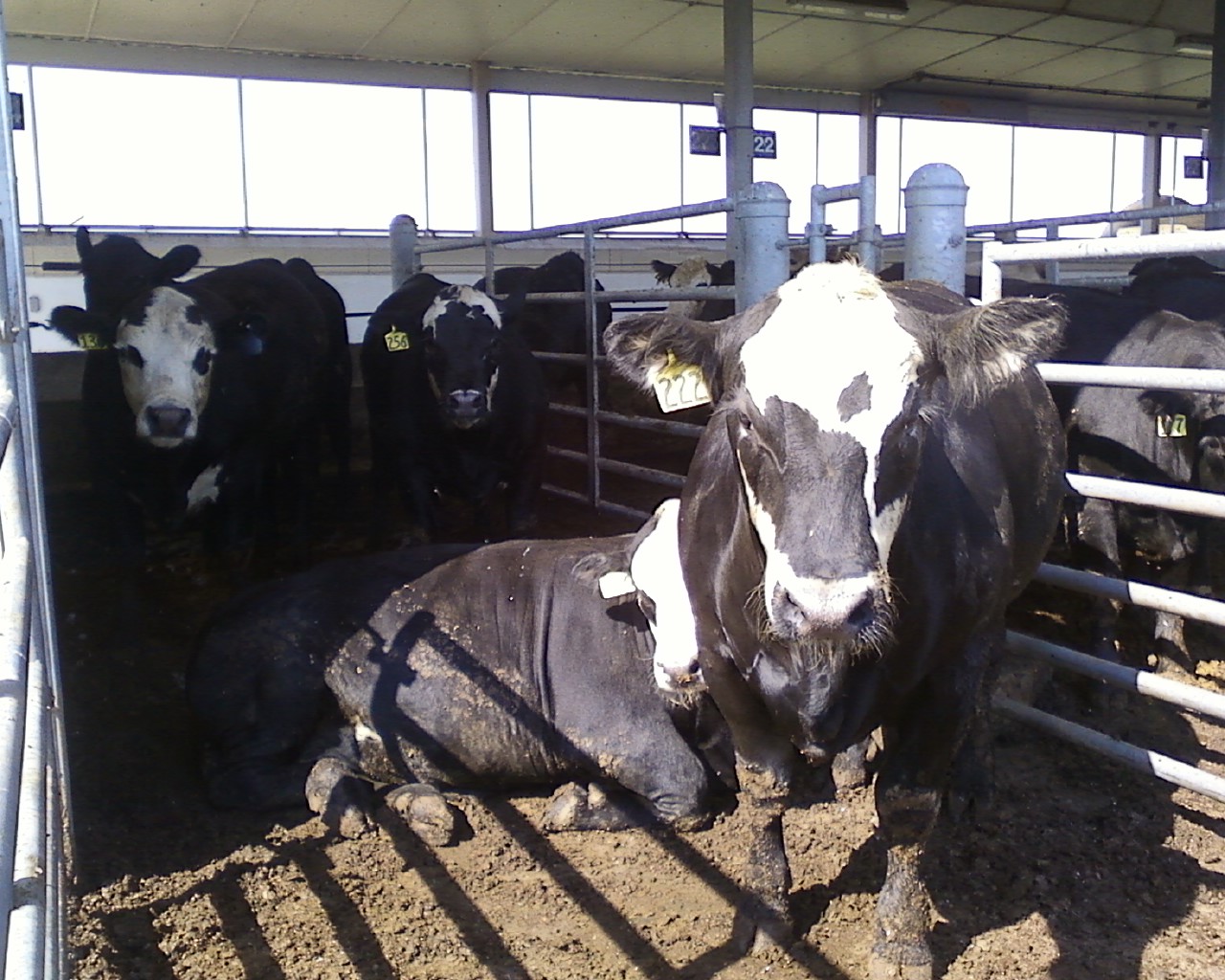
Some of our current big boys.
Now, I'm not saying we should never use antibiotics, they have their place, and play an important role in managing disease.  But they do need to be used carefully, as much in humans as in livestock.  I've often heard the call for reducing or removing all antibiotics from cattle, but just like us, animals get sick.  I can't see any reason to deny them treatment that would save them or better their quality of life just to produce an organic or all-natural product.  Judicious use is important.  Making sure that the doses given are the minimum effective, and that they are given only when needed is crucial.


A big take home for me here is that there is still a need for more and better collaboration between human and animal researchers.  Because we can do more intensive research in animal models and we have focused on how to get livestock to grow to their full potential, there is a lot of information out there that if reverse engineered might provide insight into promoting lean gain and reduced weight in people. 
What other correlations do you see between human and animal health research?

Enhanced by Zemanta

Tuesday, 14 August 2012

Getting Inside the Rumen

I wrote before about what the rumen is and a bit about how it functions.  Recently I ran across mention of fistulated/cannulated cattle on another blog.  My freinds tend to refer to them as my washing machine cows.  I see these guys every day, they are my research steers.  But I was reminded that not everyone knows about them or understands why and how they come to be.  Cannulas can be placed in other locations, but 90% of the time with cattle we are talking about rumen cannulas, so that's what I'll discuss here.

So, let's begin with just a bit of terminology.  A fistula is a hole.  Specifically it is a connection between two organ or other structures that does not normally exists.  These can occur naturally or can be created by trauma or surgery.  The cannula is the rubber or plastic piece that is inserted to keep the fistula open for access.  The tubes used for tracheotomies?  Those are cannulas.  Just much smaller than the ones we use with cattle.


The next question is always why.  Why do we need cannulated animals?  The simple answer is research.  The long answer is complicated.  Cannulated animals most commonly give us access to the rumen of the cow or steer.    This allows us to take samples from or place things into the rumen.  There are a wide variety of reasons for doing this.  Using some of the research here at the University of Kentucky for a few examples:

1) In my research, we place fescue seed directly into the rumen to induce fescue toxicosis.  Relying on the animals to eat the seed is problematic as it doesn't taste very good and one of the complications of toxicosis is reduced intake.  By placing it into the rumen through the cannula we know exactly how much each animal is receiving each day. This makes the resarch more repeatable and reliable.

2) In situ research.  In situ is Latin for in place.  By placing feed in mesh bags on strings and 'hanging' them in the rumen, we can see how much of the feed is digested over a specific amount of time under controlled circumstances.  Changing the animal's diet, the room temperature, etc changes how the feed is digested.  Better digested feed = less needed to provide the same amount of nutrients.

3) In vitro fermentation.  Again, we scientist types like Latin.  In vitro refers to experiments that simulate animal conditions in the lab.  Most often, we do gas production measurements.  By incubating rumen fluid with various feeds or additives and examining gas production (carbon dioxide & methane) we can predict how these things will affect an animal.  As bloat is a huge issue in the cattle industry, finding natural gas suppression methods is a big deal.

This video from Kansas State gives a good view inside:

I hope this helps answer a few questions.  As always, let me know if you want more information, something doesn't make sense, etc.  It's easy to forget that what I do is unusual when I have done it almost everyday for years.
Enhanced by Zemanta

Thursday, 26 July 2012

Back and Busy

I got back from Phoenix last Thursday and jumped right into the last research project for my PhD on Friday.  It's been crazy since this project involves a week of living at the farm 24/7.  But, that should mean plenty of time to write.  I've got plans for everything from Temple Grandin, to exotic cats to immunology.  

My boys settling in for the night.  They are rockstars!


Monday, 9 July 2012

Playing with Fire - Part 1

Propane
Propane (Photo credit: Wikipedia)
For most of last week I spent my days at the research farm burning propane.  Sounds awesome right?  It is, well, except for that one time I singed off an eyebrow*.  You may ask why I burning propane would be a part of getting a degree in animal nutrition.  It's really only important if you are an energeticist working with an indirect calorimetry system.

Did I loose you there?  An energeticist is a person (like me) who studies how energy is used and stored in the body.  Indirect calorimetry is simply a way of measuring how much energy is being used and what the source of that energy is.  It involves comparing the air that is breathed in to the air that is expired.  The technique can be used for any animal, even people.  Measuring the amount of oxygen disappearance and carbon dioxide appearance lets me calculate heat production, which we can equate to energy use.  

So, what does all this have to do with propane?  Well, by burning a known amount of propane I can calculate the amount of CO2 and O2 that should be consumped and used based on the complete combustion reaction**:

Propane (1-C3H8) + Oxygen (5-O2) --> Carbon Dioxide (3-CO2) + Water (4-H2O)

I compare these theoretical amounts to the amounts that my computer system records.  This is called a percent recovery and tells me if the equipment is functioning properly.

That's the basics of testing calorimetry equipment.  Any questions?  I'll talk about the test-burn itself in part 2.


*Wow did I look funny.  I'm much more careful about checking to see why the flame has gone out before relighting.  It might be that airflow has stopped and the propane has built up in the box. 

**  Gah, why won't blogger let me use subscripts?
Enhanced by Zemanta